
What Is Keeping You Awake at Night?
Running an adult social care service has never been more demanding. Whether it’s creating a positive workplace culture, responding to increasingly complex coroner’s investigations, retaining great people, or preparing for CQC assessments, today’s leaders are balancing multiple challenges every day.
These were exactly the topics explored during July’s Outstanding Society virtual meeting, where providers came together to share experiences, practical solutions and honest conversations about the realities of leading in social care.
Rather than focusing on theory, the session concentrated on advice from experienced sector leaders and partners, highlighting practical approaches that any provider can begin implementing immediately.
Culture isn’t a project – it’s every decision you make
One of the strongest themes throughout the discussion was that culture cannot be separated from leadership.
Samantha Crawley challenged attendees to think beyond policies and procedures, arguing that culture is created through every interaction, every conversation and every leadership decision.
Among the practical ideas shared were:
- Create absolute clarity around your organisation’s values.
- Make openness and transparency non-negotiable.
- Build psychological safety so people feel safe to speak up.
- Use language consistently throughout the organisation.
- Remember that culture includes everyone—not just care staff, but housekeeping, maintenance, catering, administrators, residents and families.
Perhaps the most memorable advice of the afternoon was:
“Find the person causing the most trouble… and become their best friend.”
Rather than immediately trying to remove difficult personalities, Samantha encouraged leaders to understand the behaviour behind the behaviour. Those with the greatest influence can often become your strongest advocates once they feel heard and supported.
Psychological safety builds Outstanding services
The discussion repeatedly returned to one central principle: psychological safety.
When people feel safe to:
- admit mistakes,
- ask questions,
- challenge decisions,
- share ideas,
- and seek support,
They become more engaged, more innovative, and ultimately provide better care.
Simple leadership behaviours make a significant difference:
- replacing blame with learning
- planning meaningful conversations rather than relying on an “open door policy”
- providing honest feedback that is kind rather than simply “nice”
- creating environments where everyone feels respected and valued.
These are also exactly the types of cultures increasingly recognised during CQC assessments.
Free resources to help strengthen workplace culture
Rob Hargreaves from Skills for Care highlighted a number of excellent free resources that support providers in developing positive workplace cultures.
Useful resources include:
Skills for Care – Positive Culture Toolkit
These resources include self-assessment tools, practical guidance and training sessions designed specifically for adult social care employers.
Preparing for Coroner’s investigations
Another major topic was the increasing number of Prevention of Future Death (PFD) reports being issued following Coroner’s investigations.
Samantha Crawley and Sabrina Meetaroo (Howden Insurance) provided practical advice that every provider should consider.
Key messages included:
- Start gathering evidence immediately following a significant incident.
- Don’t wait until an inquest is announced.
- Record timelines while memories remain fresh.
- Support staff throughout the process.
- Maintain honest communication with families.
- Ensure your insurance includes appropriate legal representation.
Perhaps the most valuable advice was:
Prepare as though there will be an inquest—even if there never is.
Doing so not only makes any future investigation much easier but also strengthens organisational learning.
Learn from Prevention of Future Death reports
Ruth French encouraged providers to use published Prevention of Future Death reports as learning tools within their own organisations.
These publicly available reports can be used during staff meetings to stimulate discussion around falls, choking, medicines management and other common risks.
You can search published reports here:
Judiciary UK – Prevention of Future Death Reports
Learning from the experiences of others is one of the most effective ways to improve care before incidents occur.
Retention begins with culture
When the discussion moved to workforce retention, one clear message emerged:
People rarely leave because of one thing—they leave because of how they feel.
Research shared by Skills for Care found that organisations with the lowest turnover consistently demonstrated:
- visible leadership
- supportive managers
- predictable rotas
- career development opportunities
- flexible working
- investment in wellbeing
- listening to staff and acting on feedback
Interestingly, many of these factors require little or no financial investment.
Instead, they rely on leadership behaviours that create trust and belonging.
Exit interviews should happen at resignation—not on the last day
One particularly practical recommendation was to hold exit interviews as soon as someone resigns.
Waiting until someone’s final day often means opportunities to retain valuable team members have already been lost.
Understanding why someone is leaving can sometimes uncover simple solutions such as:
- flexible working
- annual leave arrangements
- career progression
- additional support
That may prevent an unnecessary resignation.
Help shape how CQC supports improvement
During the meeting, members were also encouraged to contribute ideas about how CQC can better support quality improvement across the sector.
Feedback collected by The Outstanding Society will be presented directly at the next CQC Trade Association meeting, ensuring the voices of providers continue to shape future improvement activity.
Follow this link to include your views
Useful resources
FREE Ticket – Care Show Birmingham
Final thoughts
What made this month’s webinar particularly valuable wasn’t that it offered easy answers—it recognised the realities of leading in adult social care today.
Whether you’re navigating difficult conversations, preparing for regulatory scrutiny, supporting colleagues after a serious incident, or simply trying to retain a great team, success rarely comes from one initiative. It comes from creating a culture built on trust, openness, learning and continuous improvement.
Those organisations that invest in their people, listen carefully and remain willing to learn are not only more likely to retain talented staff—they are also the organisations most likely to deliver consistently outstanding care.
If you missed the live session, keep an eye on The Outstanding Society website and YouTube channel, where the recording and accompanying resources will be available shortly.
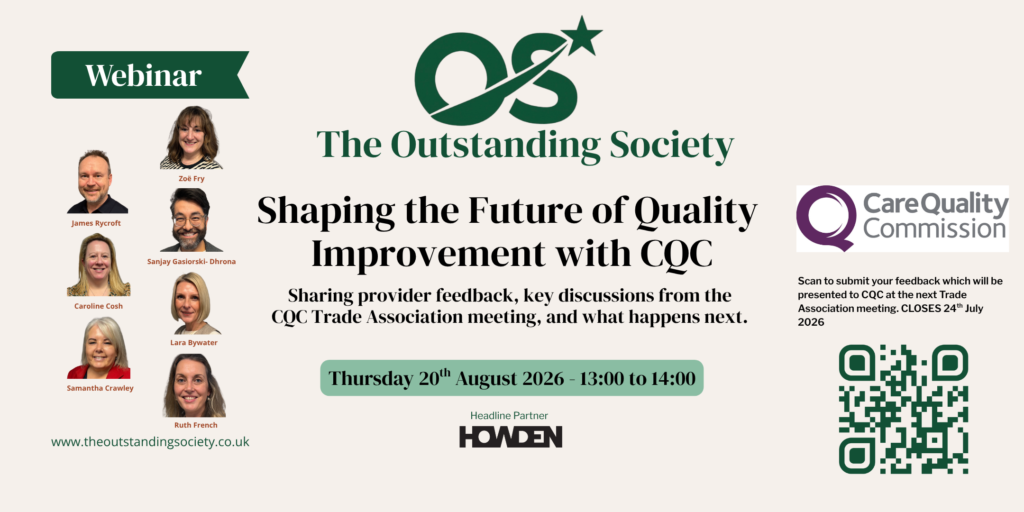
Register for your FREE place now!
Join us for the latest update from the CQC Trade Association meeting and explore how providers can shape quality improvement
We’ll provide an update on the latest discussions exploring how CQC can better support quality improvement across adult social care.
Ahead of the meeting, providers from across the sector have been invited to share their views on how CQC could strengthen its approach to supporting improvement.
If you haven’t yet contributed, you can still submit your feedback by following the link below. The survey closes on Friday 24 July.
During this session, we will:
- Share the key themes emerging from provider feedback.
- Summarise the main discussions from the CQC Trade Association meeting.
- Explore the opportunities, challenges and potential next steps arising from those conversations.
- Facilitate an open discussion on how providers can continue to influence and shape CQC’s approach to quality improvement.
Whether you completed the survey or simply want to stay informed about the latest developments, this session will provide valuable insight into the direction of travel and offer an opportunity to ask questions, share your perspective and continue the conversation about improving quality across adult social care.